
What does fulfillment cost in Portugal? Pricing and factors (2026)
Fulfillment in Portugal is charged per order, with regressive fees, plus carrier shipping costs. Learn which factors drive the final price up or down.
Afonso Andrade · Updated on 27 July 2026 · 4 min read
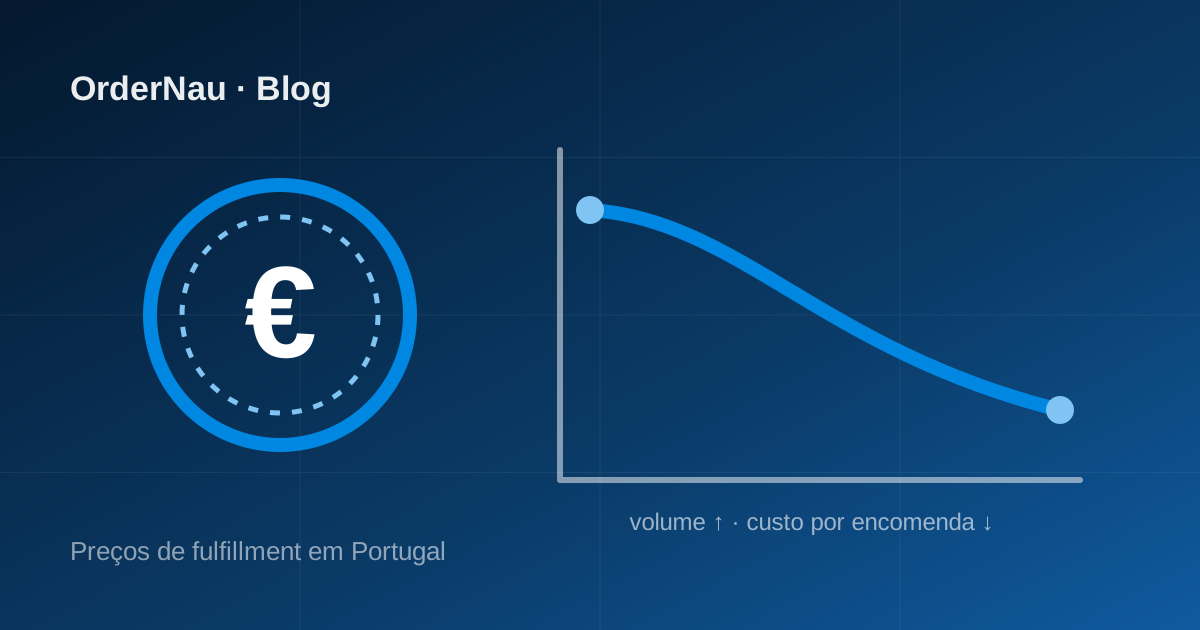
In Portugal, fulfillment costs typically have three components: a fee per processed order, which covers picking and packing, the carrier's shipping cost, and, with some operators, a warehousing fee. In regressive models, like OrderNau's, the per-order fee drops as monthly volume grows, so the exact price always depends on the store's profile.
This guide breaks down each component, the factors that move the price, and the questions worth asking before you sign. If you are still getting oriented, start with our guide to what fulfillment is.
The per-order fulfillment fee
This fee covers order intake, item picking, packing materials and dispatch preparation. What varies between operators is how it is calculated.
| Model | How it works | Best for |
|---|---|---|
| Regressive (tiered) | Per-order cost falls as monthly volume rises | Growing stores |
| Flat per order | One rate regardless of volume | Stable, predictable volumes |
| Per item (pick fee) | Base per order plus a fee per extra item | Multi-item orders |
The regressive model is the most common among operators working with growing stores, because the price follows your scale: the more you sell, the less you pay per unit.
The shipping cost
Usually the largest share of the total. It depends on the carrier (CTT, DHL, UPS, GLS or Delnext), on weight and dimensions, on the destination and on the requested speed. Here fulfillment operators hold a structural advantage: they aggregate the volume of all their clients and negotiate rates well below counter prices. In many cases, that saving alone pays for the fulfillment fee.
Warehousing
Charged per pallet, shelf or cubic metre per month, and it behaves very differently depending on stock rotation. Products that come in and go out quickly cost little to store. Stagnant stock, on the other hand, accumulates costs month after month, and this is where many merchants get surprised by the invoice. A good operator flags stagnant inventory in time for you to plan promotions or clearance.
Which factors move the price up or down?
Monthly volume weighs the most: in regressive models, more orders mean a better unit price. Then come the size and weight of your items, since bulky or heavy products cost more to store and ship, and the destinations, because shipments outside the EU require customs documentation. At OrderNau, preparing that documentation is included in a slightly higher unit cost, with our own mailbox for the UK.
Special packaging (custom boxes, tissue paper, marketing inserts), returns processing, which some operators bill separately, and extra services such as FBA prep, kitting or special labelling all add to the bill as well.
Hidden costs to check before signing
Before comparing quotes, confirm five points that rarely appear on the first page of any proposal:
- Stock intake fees: some operators charge per hour or per received pallet.
- Monthly minimums: sell little in a month, still pay the minimum.
- Integration costs: connecting your store to the operator's software may be billed separately.
- Packing materials: included, or charged per order?
- Software access: OrderNau's inventory app is free; elsewhere it may be a subscription.
The practical rule is simple: request a complete written breakdown against your real order profile (monthly volume, average weight, destinations). Any serious operator provides this simulation with no commitment.
And compared with doing it all in-house?
When putting outsourced fulfillment next to in-house logistics, the most common mistake is forgetting the internal costs that never show up on an invoice: the time of whoever packs, rent for the space, materials bought in small quantities and shipping paid at retail rates. Count those honestly and the comparison often flips.
How does invoicing work?
The market standard, and what we do at OrderNau, is a single monthly invoice on a credit-based contract: fulfillment fees, shipping and optional services all itemised at the end of the month. You know exactly what each dispatched order cost, with no surprises.
Frequently asked questions
Is there a minimum to start?
It depends on the operator. OrderNau has no hard minimum but works mainly with stores that have regular order volume. If in doubt, talk to us and we will tell you frankly whether it makes sense for your case.
Are international shipments much more expensive?
Within the EU, the difference is moderate and there are no customs. Outside the EU (UK, US, Brazil), customs documentation applies and the destination may charge import fees. An experienced operator avoids the documentation mistakes that create unexpected charges.
Can I switch operators later?
You can. The stock is yours, and switching means moving inventory and reconfiguring integrations. Prefer contracts without long lock-in periods.
Want real numbers for your store? Request a quote from OrderNau with your monthly volume and we will send a complete breakdown, no strings attached.