
What is order fulfillment? A complete guide for online stores (2026)
Fulfillment is the process of storing, picking, packing and shipping an online store's orders. Learn how it works, what it costs and when to outsource.
Afonso Andrade · Updated on 27 July 2026 · 4 min read
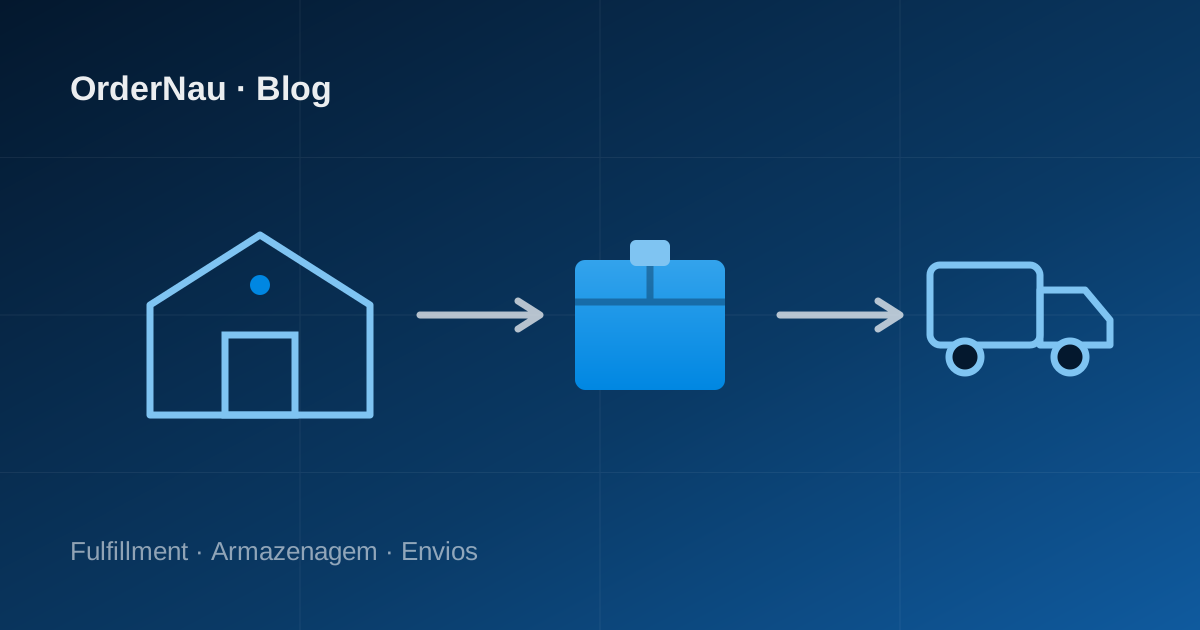
Fulfillment is everything that happens between a customer placing an order in your online store and receiving it at their door: stock warehousing, picking, packing, shipping and returns handling. When a store hands these steps to a logistics operator, known as a 3PL (third-party logistics), that is outsourced fulfillment.
In practice, outsourcing trades hours of manual work, occupied space and retail shipping rates for a fee per order. This guide explains how the process works, what is usually included, what it costs in Portugal and when outsourcing starts to pay off.
How does the fulfillment process work?
The journey is broadly the same across operators, including at OrderNau, and it starts before the first sale:
- Stock intake: you send your products to the operator's warehouse, where every item is checked, labelled and registered in the inventory system.
- Warehousing: products are stored in dedicated locations, with stock visible in real time through an app.
- Order integration: your store (Shopify, WooCommerce, OpenCart, Amazon, eBay or Vinted) connects to the operator's software, and every sale flows in automatically.
- Picking and packing: warehouse staff pick the items, pack them with suitable materials and print the shipping label.
- Dispatch: the order ships with the chosen carrier. With an efficient operator, everything received by the daily cut-off leaves the same or the next business day.
- Tracking and support: the tracking number reaches the end customer automatically, and the operator handles incidents and returns.
What does the service include?
The core is nearly always the same: store, prepare, ship, and give you visibility over all of it. Operators differ mostly in the add-ons.
| Usually included | Add-on services |
|---|---|
| Stock warehousing | Customs documentation (exports) |
| Picking and packing | Marketplace prep (FBA prep) |
| Next-business-day dispatch | Custom packaging |
| Inventory and tracking software | Sales and marketing consulting |
| Returns handling | Supplier negotiation and imports |
Not every operator offers the extras. At OrderNau, for instance, customs handling for the UK runs through our own mailbox, and the inventory management app is included at no cost.
What does fulfillment cost in Portugal?
The most common pricing model adds up two parts. The first is the per-order fulfillment fee, covering picking, packing and processing; in regressive models it drops as monthly volume grows. The second is the shipping cost itself, the carrier's rate (CTT, DHL, UPS, GLS or Delnext). Because operators negotiate the aggregate volume of all their clients, they get rates well below retail counter prices, and that difference often pays for the fulfillment fee on its own.
Warehousing may be charged on top, per pallet, shelf or cubic metre per month. We broke down every component, the tiers and the hidden costs to check in What does fulfillment cost in Portugal?
When does outsourcing pay off?
The honest calculation compares the fulfillment fee with the real cost of doing everything in-house, which includes the time of whoever packs, wages, rent, materials and mistakes. The typical signs that the tipping point has arrived: you spend more than an hour or two a day preparing orders, deadlines slip during peaks like Black Friday and Christmas, customs paperwork is holding back international expansion, stock has outgrown your space, or you are entering marketplaces with strict dispatch deadlines.
At a few orders a week, in-house fulfillment usually stays cheaper. The right moment differs per store, which is why we prefer to run the numbers on a real order profile rather than argue in the abstract.
Fulfillment, 3PL and dropshipping: what is the difference?
With fulfillment (or 3PL), the stock is yours: the operator stores it and ships orders on your behalf, while brand, packaging and customer experience stay under your control. With dropshipping you never hold stock, because the supplier ships directly to your customer; in exchange, margins and quality control are much weaker. FBA (Fulfilled by Amazon) is Amazon's own fulfillment, limited to the Amazon ecosystem and bound by strict prep rules. Many sellers use a local 3PL precisely to prep stock before sending it to Amazon's centres.
Frequently asked questions
Is fulfillment worth it for small stores?
It is, as long as order volume is regular. Operators with regressive fees and no hard minimums, like OrderNau, take on growing businesses, and the per-order cost falls as you sell more.
Do I lose control of my stock?
No. Modern operators give real-time visibility of stock levels, with automatic alerts for low stock and stagnant inventory. The store connection keeps everything in sync, as we show in the integration guide.
What if something goes wrong with an order?
A good operator takes responsibility for its own mistakes, such as damaged stock, swapped orders or late dispatch, and manages claims with the carriers. Always confirm the guarantees in the contract; ours are public in the FAQ.
Wondering how much you would save with fulfillment? Talk to the OrderNau team: we reply within one business day, with a quote tailored to your volume.